One of the most common conversations I have with property owners is about upgrades. They have capital to deploy, they want to improve their property, and they are asking the right question: where should I spend to get the best return? The instinct is almost always the same. Owners default to what they would want if they lived in the property. A remodeled guest bathroom. High-end countertops. Designer light fixtures. These are the upgrades that feel right. But feeling right and performing right are not the same thing, and the data on what tenants actually prioritize tells a very different story.
The Assumption Gap
When an owner evaluates a rental property, they tend to think like a homeowner. They notice finishes. They care about materials. They compare the property to their own home or to homes they have considered buying. That is a natural frame of reference, but it introduces a systematic bias into capital allocation decisions.
Tenants are not evaluating a property as a potential purchase. They are evaluating it as a place to live. Their decision framework is organized around daily convenience, functional reliability, and monthly cost. An owner might see a bathroom with dated tile and think "this needs updating." A tenant might see the same bathroom and think "does the water pressure work and is there storage for my things?"
The result is a predictable pattern: owners overspend on upgrades that feel impressive and underspend on features that tenants actually select for. The gap between what owners invest in and what tenants are willing to pay more for is where renovation ROI gets lost.
What Tenants Actually Prioritize
Several large-scale surveys conducted in 2025 and early 2026 provide a clear picture of what renters value most. The consistency across data sets is striking.
Apartment List's 2026 State of Renting Report, which surveyed 1,000 Gen Z and millennial renters, found that the top three non-negotiable features are in-unit laundry (44%), pet-friendly policies (43%), and central air conditioning (43%). The report noted that renters are "less interested in premiums, and more focused on what is practical."
Source: Apartment List, State of Renting: 2026 Report (survey conducted December 2025, 1,000 respondents)
Greystar's 2025 Design Survey, one of the largest in the industry at 137,000 residents, reinforced these findings. Walk-in closets topped the list at 88% interest, with 38% of respondents saying they would not rent a unit without one. Large windows and natural light came second at 87%. Secure parking ranked fourth at 84%, with renters indicating an average expected rent premium of $78 per month for covered or garage parking.
Source: Greystar 2025 Design Survey Report (137,000 residents); Multifamily Executive, January 2026
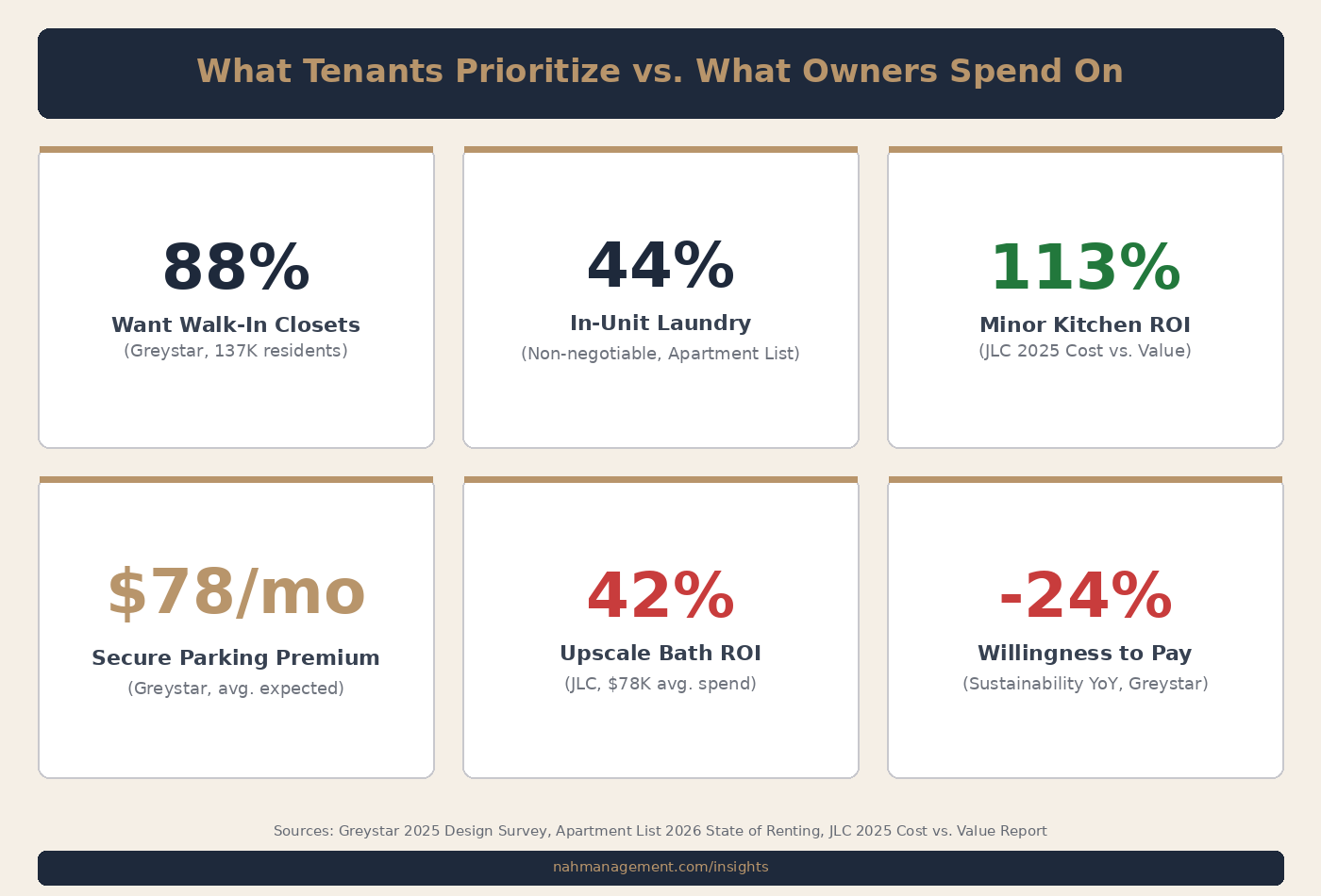
Tenant preference data vs. renovation ROI. Sources: Greystar 2025 Design Survey, Apartment List 2026 State of Renting, JLC 2025 Cost vs. Value Report.
Apartments.com search data tells a similar story. The most-searched amenities on the platform are in-unit washer and dryer, air conditioning, parking, dishwashers, and utilities included in rent. The pattern is clear: tenants search for convenience and cost predictability, not luxury finishes.
Source: Apartments.com renter preference data, reported by Paletz Law, July 2025
Where Renovation Dollars Get Wasted
The data reveals several common areas where owner spending and tenant value diverge.
Guest bathrooms over kitchens. Owners often prioritize bathroom remodels because dated bathrooms feel like the most visible problem. But the data consistently shows that kitchens have a larger impact on both rent potential and leasing speed. According to the JLC 2025 Cost vs. Value Report, a minor kitchen remodel (updated cabinets, counters, and appliances) recovers approximately 113% of its cost, while mid-range bathroom remodels recover 74% to 93% depending on the market. For rental properties, the gap is even wider because tenants spend more active time in kitchens and weigh kitchen quality more heavily in their decision to lease.
Source: Journal of Light Construction, 2025 Cost vs. Value Report
High-end finishes over functional basics. An upscale bathroom remodel averaging $78,840 recovers roughly 42% of its cost. A mid-range remodel at approximately $25,000 recovers 74% to 93% depending on the market. The pattern holds across categories: mid-range, functional upgrades consistently outperform luxury finishes on a return basis. For rental properties, the gap is amplified because tenants do not assign the same premium to materials that an owner-occupant would. A quartz countertop and a high-quality laminate may look very different to an owner. To a tenant evaluating monthly rent against features, the difference is marginal.
Source: JLC 2025 Cost vs. Value Report; NAHB Remodeling Impact Reports
Aesthetics over usability. A beautifully remodeled space that lacks functional layout, adequate storage, or reliable climate control will underperform a simpler space that gets those basics right. The RentCafe survey of 2,200 renters found that 42% prioritize closet and storage space, while 53% say well-maintained common areas significantly affect their perception of a property. Clean, functional, and well-maintained consistently outranks beautiful but impractical.
Source: RentCafe Renter Survey, 2025 (2,200 respondents)
"The question is not 'What looks best?' It is 'What makes this property easier to own and easier to rent?' This is unglamorous, and it is where ROI is often strongest."
The "Will They Pay for It?" Test
There is an important distinction between what tenants say they want and what they are willing to pay a premium for. The Greystar survey surfaced a revealing finding: while renters continue to express strong interest in sustainability features like energy-efficient lighting and fresh air ventilation, their willingness to pay for those features decreased by an average of 24% year over year.
Source: Greystar 2025 Design Survey; Multifamily Executive, January 2026
This is a critical insight for owners making capital decisions. Interest does not equal willingness to pay. A tenant may say they value energy-efficient appliances, but if two units are identical except for an Energy Star refrigerator and a $50 difference in monthly rent, many tenants will choose the lower rent. The upgrade may still make sense if it reduces the owner's operating costs (lower utility bills on owner-paid utilities, for example), but it should not be positioned as a rent-premium driver unless the market data supports it.
The features that do consistently command premiums, based on the survey data, are practical conveniences that save tenants time or money every day: in-unit laundry, secure parking, reliable high-speed internet connectivity, and functional kitchen layouts. These are the upgrades where the willingness to pay aligns with the stated interest.
A Note on Policy Decisions
Some of the highest-impact decisions for leasing performance are not renovation decisions at all. They are policy decisions.
The Apartment List survey found that 63% of Gen Z and millennial renters own a pet, and nearly half say they will always have one. For many tenants, a restrictive policy on this front is a disqualifying factor regardless of how well-appointed the unit is.
This does not mean every property should change its policies. For high-value homes with hardwood floors, premium finishes, or specific insurance considerations, there are legitimate reasons to maintain restrictions. The point is that owners should make these decisions with full awareness of the demand-side data. A policy that eliminates 40% or more of the prospective tenant pool is a meaningful leasing constraint, and the owner should weigh that trade-off deliberately rather than defaulting to a position without considering its market impact.
Source: Apartment List, State of Renting: 2026 Report
Upgrades as Operating Decisions
The most effective way to think about property upgrades is not as a design exercise but as an operating decision. Every dollar spent on a property should be evaluated through a simple framework: will this investment reduce vacancy, increase rent, lower maintenance costs, or improve tenant retention?
Some of the highest-ROI investments in rental properties are not renovations at all. Refinishing existing hardwood floors, for example, recovers an estimated 147% of cost according to the JLC Cost vs. Value Report. Fresh interior paint in neutral tones was the most common pre-listing project in 2024. Replacing cabinet hardware, updating light fixtures, and re-grouting tile are low-cost improvements that refresh a space without the risk of over-improving for the market.
Source: JLC 2025 Cost vs. Value Report
The NAHB estimates that the typical age of a U.S. home has increased from 31 years in 2006 to 41 years in 2023, and residential remodeling activity is expected to grow 3% in 2026. As housing stock ages, the question for rental property owners is not whether to invest in their properties, but where to invest for the highest return on each dollar.
Source: NAHB, February 2026; NAHB Economist Eric Lynch, International Builders' Show 2025
What This Means in Central Florida
In a market where Orlando rents have softened 4.3% year over year and vacancy is rising, the margin for error on renovation spending is narrower. Owners who over-improve relative to what the local market will bear risk capital that does not translate to rent. And in a market where more owners are entering the rental space by circumstance rather than by strategy (as we documented in our previous market analysis), the properties that are operated with discipline will stand out against those that are not.
The owners who are positioned best in this environment are not the ones with the most expensive finishes. They are the ones who understand what their specific tenant pool values, price their renovations against local market comps, and treat every capital decision as an investment with a measurable return.
Rental properties do not just need to look good. They need to perform.
If you own rental property in Central Florida and want to evaluate where your next renovation dollar should go, I welcome the conversation. Reach out through our website or connect with me on LinkedIn.