On April 9, Colorado State University released its 2026 Atlantic hurricane season forecast. The headline: 13 named storms, 6 hurricanes, and 2 major hurricanes, roughly 75% of the 1991 to 2020 average. CSU is forecasting a 15% probability of a major hurricane striking the Florida peninsula, down from the 21% historical average, and a 74% chance that any named storm passes within 50 miles of the state, compared to 86% in a typical year. The primary driver is the expected transition from weak La Nina conditions to a moderate or strong El Nino by peak season, which would increase wind shear across the Atlantic and suppress storm development.
Those numbers sound reassuring. They are not the full story.
Why Does "Below Average" Not Mean Safe for Central Florida?
A below-average season forecast predicts fewer storms forming across the entire Atlantic basin. It does not predict where those storms will go. CSU's own forecasters are clear on this point: "It only takes one hurricane making landfall to make it an active season for you." Hurricane Andrew struck during the 1992 season, which was a strong El Nino year with only seven named storms total. One of them was a Category 5 that caused $27 billion in damage.
For Central Florida specifically, the threat model is not primarily about major hurricanes making direct landfall. It is about inland flooding. Hurricane Milton in October 2024 dropped 6 to 12 inches of rain across Orange County, causing significant flash flooding along the I-4 corridor. Properties in Winter Park, Maitland, and Baldwin Park that were nowhere near a coastline experienced water damage. Many of those properties were outside designated Special Flood Hazard Areas, where flood insurance is not required by mortgage lenders and therefore rarely carried.
According to FEMA, 40% of all National Flood Insurance Program claims come from properties outside Special Flood Hazard Areas. That statistic alone should change how rental property owners in the Orlando metro think about flood risk.
What Has Changed for Property Owners Since Last Season?
Two developments since the end of the 2025 hurricane season directly affect how rental property owners in Winter Park and Central Florida should approach 2026.
Florida's wind mitigation inspection form was updated effective April 1, 2026. The Florida Office of Insurance Regulation released a revised version of the Uniform Mitigation Verification Inspection Form (OIR-B1-1802), based on a 2024 Residential Wind-Loss Mitigation Study. The new form adds two items that were not previously required: Region (design wind speed) and Roof Slope. It also re-classifies how certain roof-to-wall connections, secondary water resistance, and opening protection features qualify for insurance premium discounts. For some property owners, the updated form may result in larger wind mitigation credits than under the previous version. Insurers are expected to begin applying the new credit tables by July 2026.
This matters because a wind mitigation inspection is one of the highest-return actions a rental property owner can take. The inspection typically costs $75 to $150. The premium savings frequently exceed the cost within the first year and compound annually for as long as the inspection remains valid, which is up to five years. If you own rental property in the Orlando area and have not had a wind mitigation inspection, or if your current one is approaching its expiration, scheduling one now on the updated form is a straightforward way to reduce your insurance costs.
The National Flood Insurance Program authorization expires September 30, 2026. Congress must reauthorize the NFIP by that date, and the political environment around federal spending makes the outcome uncertain. For property owners who do not currently carry flood insurance, the spring and early summer window is the right time to lock in a policy before any potential lapse or restructuring. Under FEMA's Risk Rating 2.0 pricing, premiums are calculated based on property-specific elevation, distance to water, and rebuild cost rather than simply whether a property sits inside a mapped flood zone. For a rental property in Winter Park that is near a lake or canal but outside a high-risk zone, an NFIP policy can cost $500 to $600 per year. That is a relatively modest cost to transfer a risk that Hurricane Milton demonstrated is very real for inland Central Florida properties.
"A below-average hurricane forecast is the best possible time to prepare. Insurance is cheaper to buy when no one is looking at the radar. Inspections are easier to schedule when contractors are not booked out. Every action taken before June 1 is less expensive and less stressful than the same action taken in August."
What Should Rental Property Owners in Winter Park and Orlando Do Before June 1?
Schedule a wind mitigation inspection on the new April 2026 form. If your property has hurricane shutters, impact windows, a newer roof with proper fastening, or secondary water barriers, these features may now qualify for different credit tiers under the updated OIR-B1-1802. Even if your current inspection is still valid, a fresh inspection on the new form could change your premium. Contact a licensed inspector who is certified on the 2026 form and has experience with properties in Winter Park and the surrounding communities.
Evaluate whether you need flood insurance. If your rental property is near any body of water in the Orlando metro, including lakes, retention ponds, canals, or low-lying areas prone to standing water, get a flood insurance quote. Standard homeowners insurance does not cover flood damage. The properties most at risk are often the ones without coverage, because they sit outside mapped flood zones and their owners assume they are safe. Milton proved otherwise across Central Florida.
Review your property's exterior condition. Loose fence panels, damaged soffits, aging roof tiles, overgrown trees with branches near the roofline, clogged gutters, and improperly graded landscaping are all conditions that turn a manageable storm into an insurance claim. Addressing them in May costs a fraction of what emergency remediation costs in September. For owners who are not local, this is exactly the type of proactive maintenance oversight that a property management company handles as part of routine operations.
Confirm your insurance coverage amounts. Rebuilding costs in Florida have risen significantly over the past several years. As we covered in our analysis of Florida's $8,300 insurance premium, what cost $400,000 to rebuild five years ago may now cost $600,000 according to Tower Hill Insurance estimates. If your Coverage A dwelling amount has not been updated recently, you may be underinsured. Contact your insurance agent and request a current replacement cost estimate before hurricane season begins.
Talk to your tenants. Tenants need to know what is expected of them during a hurricane watch or warning. Where are the storm shutters stored? Who installs them? What is the evacuation route? Who do they call if there is damage? Properties managed by NAH Management have a documented hurricane preparation protocol that covers all of these questions. If you are self-managing, this is the time to put that plan in writing and share it with your tenant.
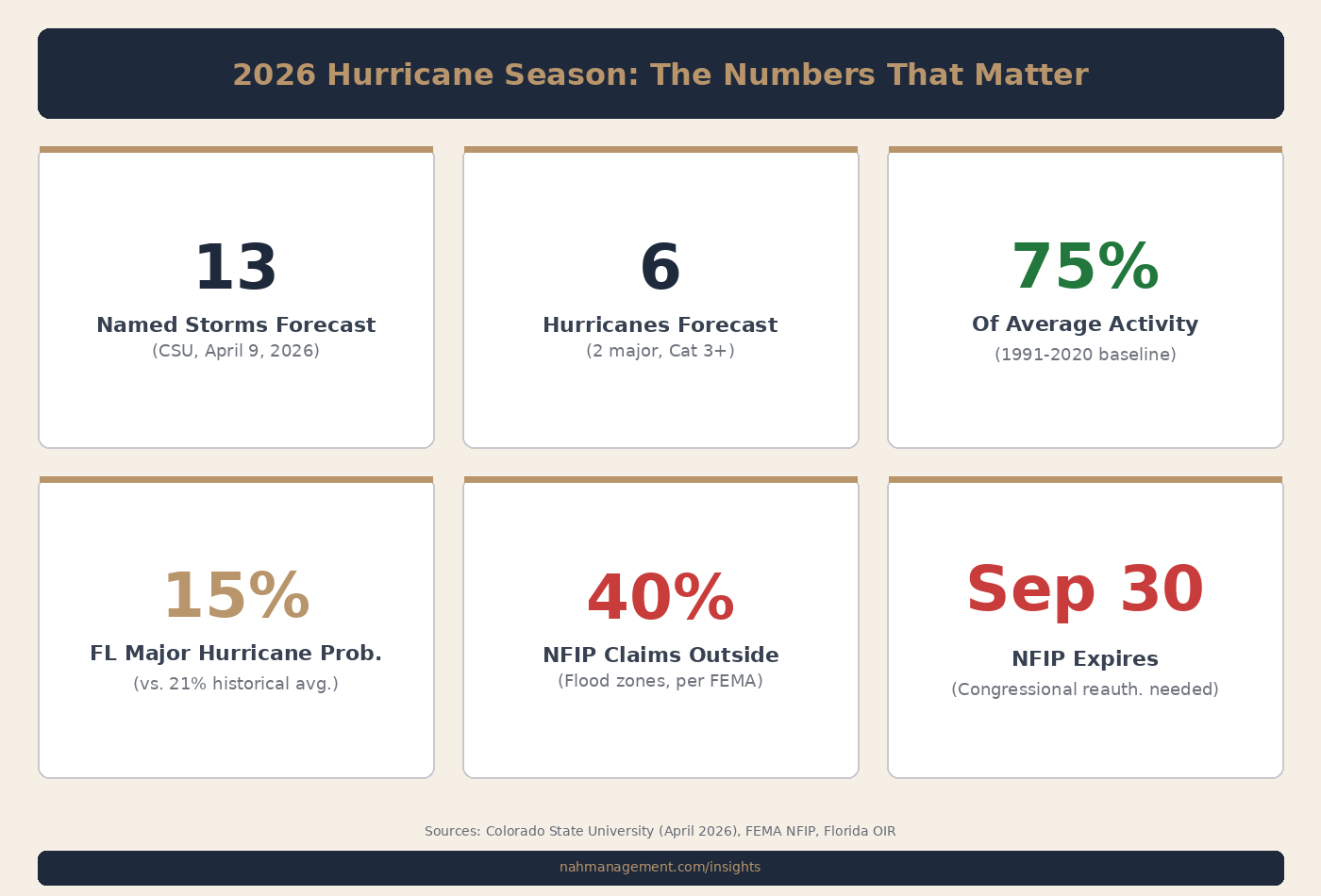
2026 hurricane season by the numbers. Sources: Colorado State University (April 9, 2026), FEMA National Flood Insurance Program, Florida Office of Insurance Regulation.
What the 2025 Season Reminded Us
The 2025 Atlantic hurricane season produced 13 named storms, 5 hurricanes, and 4 major hurricanes, including three that reached Category 5 intensity. Hurricane Melissa made landfall as a Category 5 in Jamaica, causing nearly $9 billion in damage and 95 fatalities across the Caribbean. While Central Florida avoided a direct hit in 2025, the season underscored that the Atlantic remains capable of producing powerful storms regardless of preseason forecasts. CSU's own April 2025 forecast called for 105% of average activity, which is exactly what occurred. The forecast was accurate on totals but could not predict where individual storms would track.
The Bottom Line for Central Florida Property Owners
A below-average hurricane season does not mean a safe one. It means fewer storms in the basin, not fewer storms in your zip code. For rental property owners in Winter Park, Baldwin Park, Maitland, College Park, and across the Orlando metro, the month of May is the most valuable preparation window of the year. Insurance is cheaper to buy before hurricane season begins. Inspections are easier to schedule. Contractors are available. Every dollar spent on preparation before June 1 is more effective than the same dollar spent reactively after a storm watch is issued.
At NAH Management, hurricane preparedness is part of how we operate year-round. From proactive exterior maintenance and vendor coordination to insurance claim management and tenant communication protocols, storm readiness is built into our management approach, not bolted on as an afterthought. If you own rental property in Central Florida and want to make sure your property is ready for the season ahead, reach out for a conversation.
Sources
Colorado State University Tropical Meteorology Project, "Extended Range Forecast of Atlantic Seasonal Hurricane Activity," April 9, 2026. CSU Department of Atmospheric Science, Dr. Phil Klotzbach et al. Florida Office of Insurance Regulation, Uniform Mitigation Verification Inspection Form OIR-B1-1802 (Rev. 04/26), effective April 1, 2026. FEMA, National Flood Insurance Program Congressional Reauthorization, current authorization through September 30, 2026. FEMA Risk Rating 2.0 methodology. ClickOrlando/News 6, "Colorado State University issues 2026 Atlantic hurricane season forecast," April 9, 2026.