Most rental properties do not fail because the market turned against them. They underperform because of how they are operated. According to the Hemlane 2026 Rental Owner Report, 55% of rental owners named rising expenses as their number one concern, ahead of vacancy rates, interest rates, and regulatory changes. 42% identified tenant turnover as their single biggest operational challenge. And 74% of independent landlords reported that their ownership costs increased this year, driven by property taxes, insurance, maintenance, and utilities. The pressure is real. But the response to that pressure is what separates a property that performs from one that does not.
In my experience in real estate finance, the properties that underperform almost always share the same four operational failures. Not one of them is caused by the market. Every one of them is caused by how the property is managed.
1. Rent Is Mispriced
This is the most common and most quietly destructive problem in residential property management. An owner sets the rent based on what the last tenant paid, what a neighbor mentioned in passing, or what a quick search on Zillow suggested. None of these are market analysis. They are guesses.
Rent mispricing works against the owner in both directions. Set the rent too high and the property sits vacant. Every week of vacancy on a property renting at $3,500 per month costs the owner $875 in lost income. Set it too low and the owner collects less than the market supports for the entire duration of the lease. On a 12-month term, underpricing by just $200 per month costs $2,400 in foregone revenue, money that never comes back.
In a market like Central Florida, where population growth is adding 725 new residents per week and the tenant profile is shifting toward internationally sourced professionals, static pricing based on last year's lease is not a strategy. It is a default. Accurate rental pricing requires continuous analysis of comparable properties, current absorption rates, seasonal demand patterns, and property-specific features that affect what a tenant is willing to pay. The Hemlane report found that only 13% of owners rank rental pricing as their top challenge, which suggests most do not realize how much revenue they are leaving on the table.
2. Turnover Is Too Expensive
The 2026 Buildium/NARPM Industry Report estimates that each tenant turnover event costs between $2,000 and $5,000, factoring in vacancy loss, cleaning, repairs, marketing, showing time, and lease-up. For higher-value single-family homes in Winter Park, Baldwin Park, or Maitland, that number is often higher because the make-ready scope is larger and the vacancy cost per day is greater.
42% of rental owners in the Hemlane survey identified turnover as their single biggest challenge. That figure should concern every property owner, because turnover is largely preventable. The Buildium/NARPM data shows that the number one driver of tenant non-renewal is slow maintenance response. Not rent increases. Not lease terms. Slow maintenance. Tenants leave properties where they feel ignored, and they stay in properties where issues are addressed promptly and professionally.
The math on retention versus replacement is not close. Retaining a quality tenant for an additional year at a modest 3% rent increase costs nothing in vacancy, nothing in make-ready, and nothing in re-leasing. Replacing that tenant costs $2,000 to $5,000 and resets the clock on relationship building. Owners and managers who invest in responsiveness, routine maintenance, and proactive renewal conversations will always outperform those who treat tenants as replaceable.
"None of these are market problems. They are operational problems. The market does not cause a property to sit vacant for 60 days in a submarket with strong demand. That is a management failure."
3. Tenant Selection Is Rushed
When a property sits vacant, the pressure to fill it creates a temptation to lower screening standards. Accept the first applicant who can pay the deposit. Skip the landlord reference check. Overlook the gap in employment history. These shortcuts save a few days of vacancy and create months of problems.
A poorly screened tenant who pays late, damages the property, or breaks the lease early costs far more than the vacancy the owner was trying to avoid. The Buildium/NARPM report found that maintenance costs have risen 15% to 25% since 2022, with the average HVAC replacement now running $5,000 to $8,000. When a tenant who was placed hastily neglects basic care of the property, or when a lease is broken and the unit turns over mid-winter, those costs accelerate.
Screening is not a cost center. It is risk management. Income verification, credit history, rental history with direct landlord contact, employment confirmation, and background checks are not optional steps in the process. They are the process. Every dollar spent on thorough screening is recovered many times over in avoided damage, avoided legal costs, and avoided early termination. In a market like Orlando, where the U.S. Census Bureau just reported a Q1 2026 rental vacancy rate of 7.3% nationally, the tenant pool is large enough to be selective. Owners who lower their standards to fill a unit faster are making a decision they will regret within six months.
4. No One Is Watching
This is the failure that ties the other three together. A property where no one is actively monitoring rent alignment, tracking maintenance requests, enforcing lease terms, and evaluating financial performance on a monthly basis is a property that will drift toward underperformance. It is not a question of if. It is a question of when.
As we covered in our recent article on the five signs an owner is about to fire their property manager, 67% of owners who terminate a management relationship cite lack of transparency. The same dynamic applies to self-managing owners who do not hold themselves to a reporting standard. If you do not know your property's current market rent, your year-over-year expense trend, your average vacancy duration, and your net operating income this quarter versus last quarter, you are not managing the property. You are hoping it works out.
The Hemlane data confirms this: 82% of rental property owners reported increased costs of ownership in the past year, with property taxes affecting 60%, maintenance and repairs 57%, utilities 49%, and insurance premiums rising across the board. These are not numbers that absorb themselves. They require active management. Reviewing vendor invoices. Comparing insurance quotes annually. Scheduling preventive maintenance that reduces emergency repair costs. Adjusting rent at renewal to reflect current market conditions. None of this happens passively.
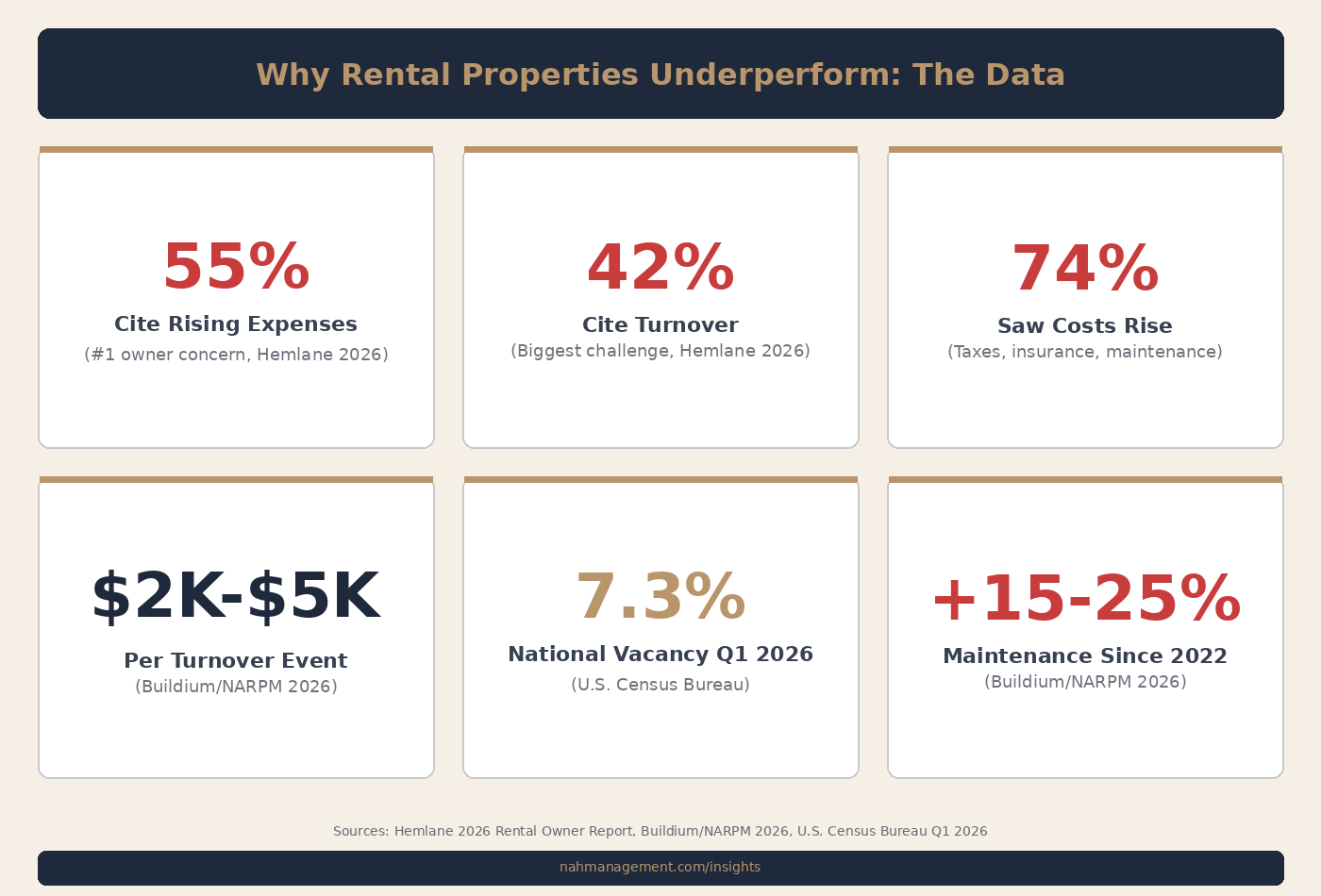
Why rental properties underperform. Sources: Hemlane 2026 Rental Owner Report, Buildium/NARPM 2026 Industry Report, U.S. Census Bureau Q1 2026.
What Changes When Operations Are the Priority?
The difference between a property that performs and one that does not is rarely the property itself. It is rarely the market. It is the quality of the operation behind it. When rent is priced based on real-time analysis rather than guesswork, vacancy shrinks. When tenants are screened rigorously rather than hastily, lease violations and early terminations drop. When maintenance is handled proactively rather than reactively, costs go down and tenant satisfaction goes up. And when all of this is tracked, reported, and reviewed on a monthly basis, the owner can see exactly where value is being created and where it is leaking.
That is the difference between treating a rental property as a passive holding and operating it as a performing asset. The Hemlane report found that more than 80% of rental owners describe themselves as neutral to optimistic about the current rental market. That optimism is earned by the owners who operate with discipline. It is misplaced for the owners who do not.
At NAH Management, this is the foundation of how we operate in Winter Park and across Central Florida. Every property we manage is priced against current market data. Every tenant is screened against a consistent standard. Every maintenance request is tracked and resolved with documented vendor coordination. And every owner receives transparent monthly reporting that shows exactly how their property is performing. These are not premium features. They are the baseline.
If your rental property is not performing the way you expected, the answer is almost never to sell it. The answer is to operate it differently. Reach out for a free evaluation and let us show you where the gaps are.
Sources
Hemlane, "2026 Rental Owner Report," published 2026. Buildium and NARPM, "State of the Property Management Industry Report," 2026 edition. U.S. Census Bureau, Housing Vacancies and Homeownership, Q1 2026 (released April 28, 2026). Baselane, "2024 Rental Property Owner Cost Survey."