
I spent over two decades in institutional finance, working at firms like Deloitte, UBS, Deutsche Bank, and MD Sass. In those environments, every asset class is managed with the same foundational discipline: clear performance metrics, transparent fee structures, governance controls, and alignment between the manager and the investor. When I transitioned into residential real estate, I expected to find a version of that same rigor applied to rental properties. What I found instead was an industry that had barely evolved in 20 years.
Most property management companies still operate on a simple formula: collect rent, coordinate repairs, charge a percentage. It works. Tenants get housed, owners get a monthly statement. But there is a structural misalignment buried in that model that most owners never think to question, and it quietly erodes the performance of their investment over time.
The Problem with the Traditional Model
In conventional property management, the manager earns a flat percentage of collected rent. Whether your property performs exceptionally or underperforms, the management fee stays roughly the same. The manager has no structured incentive to reduce vacancy, optimize rent pricing, contain maintenance costs, or protect the long-term value of your asset. They are compensated for administration, not performance.
On top of that base fee, traditional managers typically layer additional charges: leasing fees when a new tenant is placed, renewal fees when an existing tenant re-signs, maintenance coordination markups, and sometimes even inspection fees. These charges create a counterproductive incentive structure. A leasing fee, for example, means the manager earns more revenue every time a tenant turns over. That is a direct conflict with the owner's interest in long tenancies and low vacancy.
When you add it all up, an owner who believes they are paying 8 to 10 percent for management is often paying 12 to 18 percent of annual rent once placement fees, renewal fees, and various surcharges are factored in. The headline rate and the actual cost diverge significantly, and the disconnect is rarely surfaced until an owner runs the numbers across a full investment cycle.
What Asset Operations Looks Like
When we started building NAH Management, my co-founder Gorken Mimioglu and I asked a straightforward question: what would property management look like if it were designed today, from the ground up, for investors who think about their rental homes the way institutional investors think about any performing asset?
The answer was not to build a cheaper version of the same model. It was to build a different model entirely. One structured around transparent economics, operational discipline, performance alignment, and institutional-grade reporting.
"Residential rental homes are investment assets. They should be operated like one."
In practice, this means rethinking how the manager is compensated, what the owner actually sees, and how operational decisions are made. It means moving from property management to what we call asset operations.
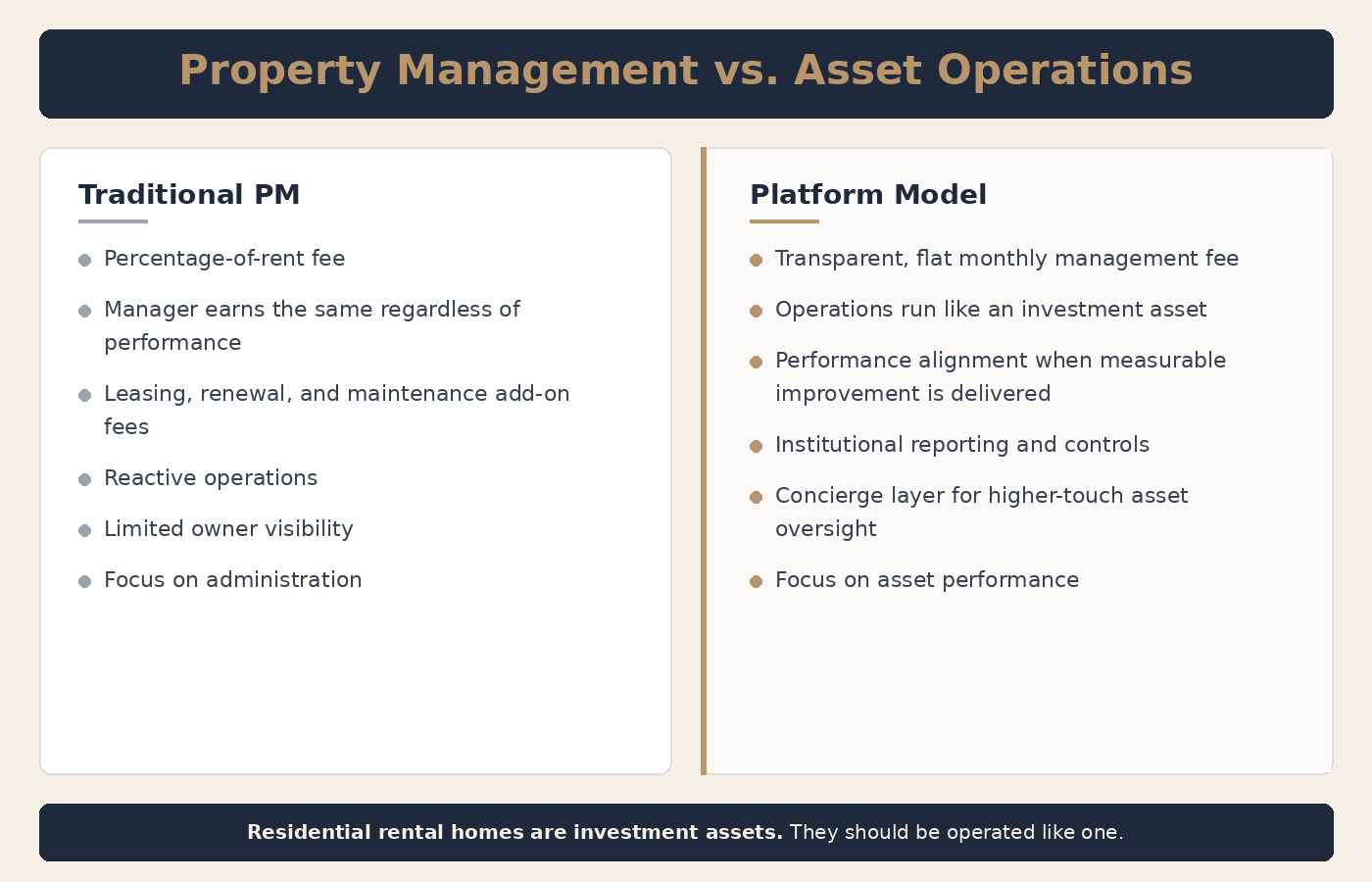
Traditional property management focuses on administration. An asset operations model focuses on investment performance.
Transparent Platform Economics
NAH Management's fee structure was designed to eliminate the hidden cost problem entirely. We charge a flat monthly management fee indexed to the property's rent, with no leasing fees, no renewal fees, and no maintenance coordination markups on the base tier. An owner who engages us knows exactly what they will pay, and the number does not change based on tenant turnover or maintenance volume.
By removing leasing and renewal fees from the equation, we eliminated the structural incentive to churn tenants. Our financial interest is now aligned with the owner's: place a high-quality tenant quickly, retain them for as long as possible, and minimize the vacancy and turnover costs that erode net operating income.
Performance Alignment
Beyond the base fee, NAH offers a performance participation component. This is not a penalty or an additional charge layered on top. It is earned only when we deliver measurable improvement to the property's financial performance. Think of it the way an institutional investor thinks about carried interest: the manager participates in the upside they help create, measured against defined metrics including rent growth, vacancy reduction, NOI improvement, and cost containment.
This structure means our team is economically motivated to optimize every lever that drives your property's returns. If we do not improve performance, we do not earn performance participation. It is that simple.
| Dimension | Traditional PM | Asset Operations (NAH) |
|---|---|---|
| Fee transparency | Advertised rate + hidden add-ons | Flat fee, fully transparent, no add-ons |
| Leasing fees | 50-100% of first month's rent | None |
| Renewal fees | $150-$300 per renewal | None |
| Performance incentive | No structured alignment | Earned on measurable improvement |
| Reporting | Monthly statement | Institutional-grade asset reporting |
| Technology | Basic portal | Intelligent automation, 24/7 response |
| Maintenance oversight | Reactive, markup-driven | Proactive, governed, concierge-tier available |
| Operational focus | Administration | Asset performance |
Institutional Reporting and Controls
In institutional finance, you would never invest in a fund that sent you a single-page summary once a month and called it reporting. Yet that is the standard in residential property management. Owners receive a rent ledger, maybe a maintenance log, and a disbursement amount. There is very little visibility into how operational decisions affect the property's long-term performance.
At NAH, we are building reporting that gives owners the kind of asset-level visibility they would expect from any other investment. That means tracking not just rent collected and expenses paid, but vacancy rates against market benchmarks, rent positioning relative to comparable properties, maintenance cost trends, tenant retention rates, and the net operating income trajectory of the asset over time.
This is not reporting for the sake of data. It is reporting that enables informed decisions. When an owner can see exactly how their property compares to the local market, they can make better choices about capital improvements, rent adjustments, and long-term hold strategy.
A Concierge Layer for Higher-Touch Oversight
Not every owner needs the same level of involvement. Some prefer to review a quarterly report and trust the operator to handle everything in between. Others, particularly those with higher-value properties or portfolios, want a more hands-on approach to asset oversight: proactive capital planning, vendor governance, renovation project management, and direct access to their management team on demand.
NAH's concierge subscription was designed for that second group. It provides guaranteed priority access, preferred pricing on vendor services, and project-level oversight for owners who want their property treated with the same rigor as a commercial asset. It is a defined service tier with transparent pricing, not a menu of surprise charges.
Why This Matters for the Market
Central Florida's rental market, particularly the Winter Park corridor, has matured significantly over the past several years. Average rents have risen, investor interest has increased, and the quality expectations of tenants have gone up alongside them. The days when a rental property could be passively managed and still perform are giving way to a more competitive environment where operational discipline directly impacts returns.
For owners with one property or ten, the question is not whether you need a property manager. It is whether your manager is structured to protect and grow the value of your investment, or simply to administer it.
That distinction, between property management and asset operations, is what we built NAH around. It informs every decision we make, from how we price our services to how we select tenants, manage vendors, and report performance back to owners.
Comparing Notes
If you own investment property in Central Florida or work with investor clients, I am always interested in comparing notes on what modern rental operations should actually look like. The industry is evolving, and the owners and advisors who are thinking critically about how their properties are managed will be the ones best positioned as the market continues to mature.
You can reach me directly through our website or connect with me on LinkedIn. I welcome the conversation.