
Every March, the U.S. Census Bureau releases updated population estimates for metro areas across the country. The data released in March 2026 for the year ending July 2025 tells a clear story about Orlando: this region is still growing, but how it is growing has changed in ways that matter for anyone who owns rental property here.
The Headline Numbers
Orlando's population reached 2,957,672 at mid-year 2025, adding 37,690 new residents, or roughly 725 per week. That growth rate of 1.3% is well above Florida's statewide rate of 0.8% and ranks Orlando as the sixth fastest-growing metro among the 30 most populous in the country. For context, Orlando added nearly three times as many residents as Tampa, while Miami lost population during the same period.
This is a slowdown from 2024, when Orlando added over 56,000 residents and ranked first among major metros at 2.7% growth. But the broader trend remains clear: people continue to move to this region at rates that far exceed the national average.
Where the Growth Is Coming From
This is where the data gets more interesting for property owners. Of the 37,690 new residents added in 2025, approximately 82% came from international migration. That is roughly 29,000 people. Domestic migration, on the other hand, turned negative: more people left the Orlando metro for other parts of the United States than moved in from them. The region lost a net 1,785 domestic residents in 2025.
That shift matters. International migrants tend to rent first. Many arrive without established credit histories, existing homeownership, or immediate access to mortgage financing. They represent a reliable, structurally driven source of rental demand that is distinct from the domestic buyer-to-renter cycle. For owners with well-maintained properties in accessible neighborhoods, this population shift reinforces occupancy.
At the same time, the domestic outflow signals something important: Central Florida is no longer the automatic destination it was during the pandemic migration surge of 2020 through 2023. Cost of living, insurance, and housing affordability are redirecting some domestic movers to other markets. Owners who assume demand will take care of itself are operating on outdated assumptions.
The County-Level Story
The growth is not distributed evenly. In 2025, 75% of all net migration to the Orlando metro went to Lake and Osceola counties, despite those two counties accounting for only 32% of the region's population. Orange and Seminole counties, where Winter Park, Maitland, Baldwin Park, and College Park are located, both experienced net domestic outflows and relied almost entirely on international migration and natural growth to maintain their populations.
County-level data also shows evidence of intra-regional migration: residents moving from Orange and Seminole to Lake and Osceola in search of lower housing costs. Since 2020, almost two-thirds of all net migration to the region has gone to those two outlying counties.
"Orlando's rental demand is not speculative. It is driven by structural migration patterns that create a consistent need for housing. But where that demand concentrates, and who it serves, is changing year over year."
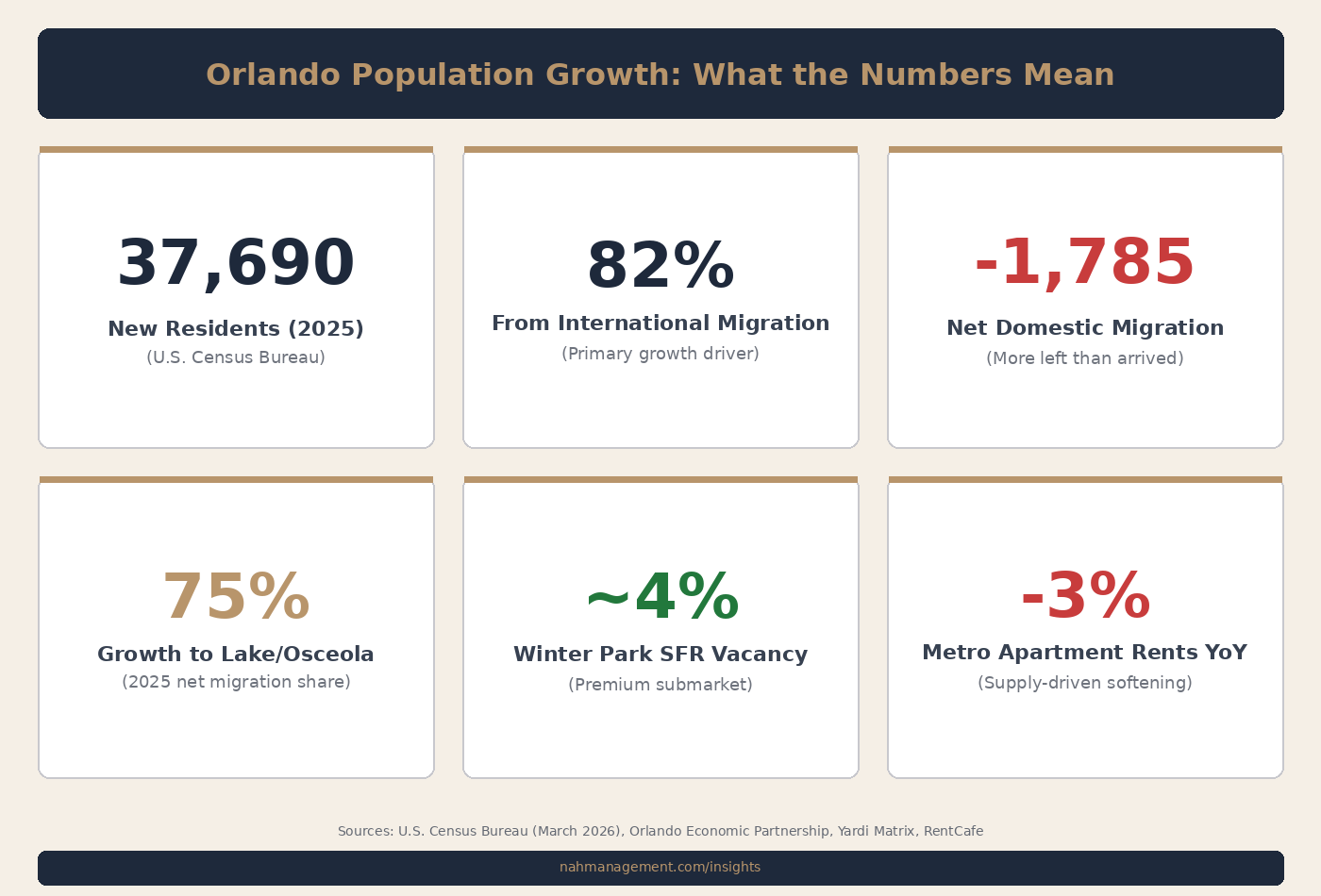
Orlando population growth at a glance. Sources: U.S. Census Bureau Population Estimates (March 2026 release), Orlando Economic Partnership Market Commentary (March 2026).
What This Means for Rental Property Owners
There are three practical takeaways for owners in Winter Park, Baldwin Park, College Park, Maitland, and the surrounding communities.
The tenant profile is shifting. When 82% of new residents come from international migration and net domestic migration is negative, the composition of rental demand changes. A significant share of these new residents will enter the rental market before purchasing, if they purchase at all. That is not speculation; it is a function of how international relocation works. Mortgage qualification, credit history establishment, and home purchase timelines mean that international arrivals are structurally more likely to rent, and to rent for longer, than domestic movers. For property owners, this means the pool of prospective tenants is changing in composition. Owners and managers who understand that shift and adjust their screening, marketing, and communication accordingly will capture the strongest tenants from that pool.
Orange and Seminole are losing domestic residents to Lake and Osceola. The intra-regional migration pattern is clear: cost-conscious domestic movers are shifting outward. That does not mean Orange and Seminole are weakening. It means the growth in these counties is being sustained almost entirely by international migration and natural change, not by domestic arrivals. For owners in NAH's core service areas, this is an important signal. The tenant pool is being shaped by a different migration source than it was three years ago, and owners who pay attention to who is actually arriving in the region will make better decisions about how they present and manage their properties.
Population growth is no longer automatic. The Census data makes this explicit: domestic in-migration turned negative in 2025, and recent changes in U.S. immigration policy introduce uncertainty around future international arrivals. The Orlando Economic Partnership's own framing is direct: future growth will need to be earned. For property owners, this means the days of passive demand, where any vacant property would fill itself regardless of condition or management, are over. The underlying demand is still strong at 725 new residents per week. But capturing that demand now requires intentional positioning, professional management, and a property that meets the expectations of the people who are actually arriving.
Growth Must Be Earned
Orlando is not correcting. It is maturing. The region remains one of the fastest-growing metros in the country, and the structural drivers of rental demand, population growth, international migration, job creation, and limited single-family supply, are intact. But the character of that growth is evolving, and owners who pay attention to the data will make better decisions than those operating on assumptions from 2022.
At NAH Management, we track these trends because they directly inform how we advise our owners on tenant screening, property positioning, and market strategy. If you own rental property in Central Florida and want to understand how this data applies to your specific situation, reach out for a conversation.
Sources: U.S. Census Bureau Population Estimates (March 2026 release), Orlando Economic Partnership Market Commentary (March 2026).